By: The Story Time Storytellers
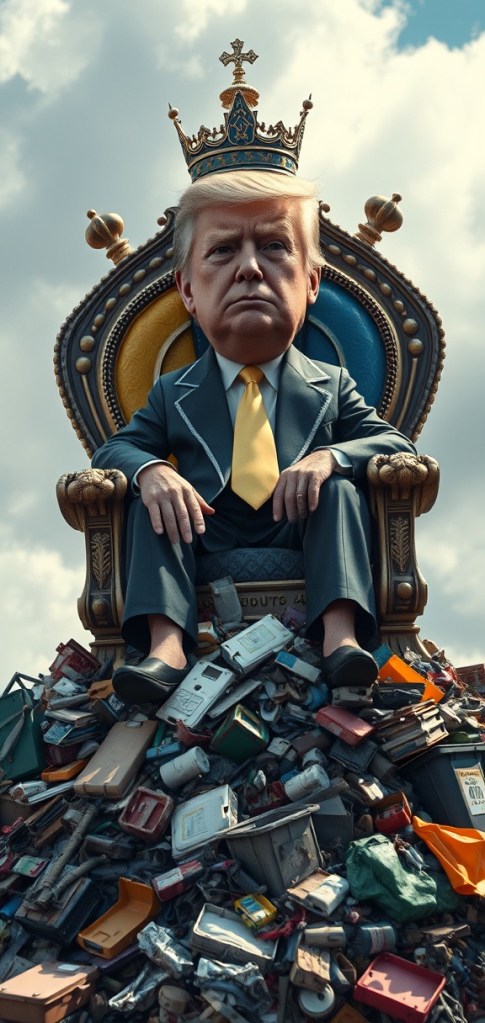
Once upon a time, in a world not too different from our own, there was a man whose name we shall not use. Instead we will refer to him as the title he was eventually given and is now remembered for all time: The Dumpster King. He was born into a life of wealth and privilege, inheriting everything from a father who was known across the land for his cruelty, bigotry and malice. His father, a man who wandered the world with hatred in his heart and disdain for all who were “beneath” him, left The Dumpster King a fortune built on suffering, deceit, and broken promises. Yet, The Dumpster King was not bothered by the bloodstains on his inheritance. He never questioned how he came to own what he did. All that mattered to him was that it was his.
The Dumpster King was not an intelligent man. He lacked the brilliance or wisdom that one might expect from a person of his stature. In fact, he was one of the most ignorant fools to ever walk the earth. But he was clever enough to understand one thing: people would believe whatever they were told if it was repeated often enough. So, he spent his early years building an image of brilliance, of greatness, while hiding his ignorance behind a façade of wealthy charm and cash-confidence.
Through sheer manipulation, The Dumpster King became a master of persuasion. He spoke in grandiose terms, claiming to be the one who understood the world’s true problems when, in fact, he knew nothing of them. He convinced the people that their current rulers—who were competent, albeit flawed—were destroying the nation. By using simple words and phrases, and with promises of a new dawn and a brighter future, The Dumpster King convinced the masses that he was their savior, their genius, their path to greatness.

Soon, The Dumpster King had the nation kneeling at his deformed feet and kissing his tiny little sausage hands, all of them convinced that the struggles they had faced for so long were the result of some deep, dark enemy. He claimed he would weed out this invisible enemy and he promised them prosperity, freedom, and a return to greatness, though he had no true understanding of how to achieve any of it.
With the help of technological advances, modern propaganda, utilizing algorithms within a newly created social media that claimed it would bring the world together, an entire society willingly accepted this new and convenient creation and convinced themselves to give away their freedom. The nation, tired of the old ways, welcomed him with open arms, unknowingly handing over their freedom in exchange for empty promises. They believed they had chosen him of their own free will, not realizing their consent had been manipulated through years of lies and deception. A deception they held in the palm of their hands. Gripping it like an idol and refusing to let it go.
But the lies didn’t stop there. The Dumpster King, with his inherited fortune and newfound power, began to dismantle the very institutions that had kept the country stable. He redirected resources into his own pockets and those of his wealthy cronies, leaving the citizens destitute. Once prosperous cities crumbled, and the once-vibrant nation began to wither under his rule. But The Dumpster King’s greatest weapon was not his wealth—it was fear.
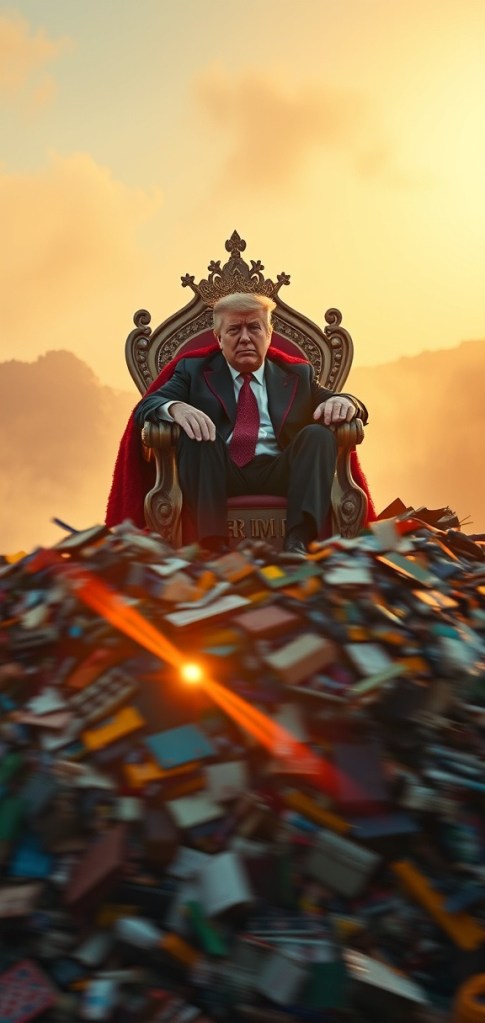
The Dumpster King convinced the people that their neighbors to the West, once allies standing shoulder to shoulder against tyrannical forces, were now conspiring against them. He made them believe that foreign nations sought their destruction. And so, in the name of national protection, he started wars. Wars that were unnecessary, unjust, and devastating, but wars nonetheless. The citizens, already suffering from his policies, now found themselves dragged into global conflicts. The whole world descended into chaos as nations were pitted against each other in a war that no one truly understood.
The Dumpster King collaborated with dictators, oligarchs, and shadowy henchmen from enemies of old that had been quietly hiding in The East. Thus, at the same time he waged war, he was able to convince the people he was bringing peace and a new world order. A “Golden Age.” In truth, he was sinking and sniveling to the will of the nation’s enemies. Whispers swirled that The Dumpster King had been bought and was merely a puppet being controlled by outside enemy entities and agitators.
Military heroes and leaders began signaling to the nation’s citizens there was detailed evidence that he had been groomed early on by enemy intelligence. Information was shared regarding how he was viewed by certain Eastern nations with unflattering descriptions. Discussions were allegedly had where many leaders recognized that the young Dumpster King was intellectually vulnerable, psychologically and spiritually vapid, and prone to high praise. Having achieved that analysis, the nation’s true enemies pounced, assisting to bring him to power. In short, there was great concern that he had been compromised. That he had become an asset to the enemy. But, those concerns were ignored, or drowned out by an ocean of daily propaganda.
It did not take long for the world to be left in ruins. The people, once thriving in their own lands, were now broken and destitute, struggling to survive in a world torn apart by The Dumpster King’s ignorance and ambition. Yet, despite the wreckage, the citizens continued to believe in him. They believed he had been sent by some higher power, a gift from the heavens meant to lead them to salvation. They believed the war and destruction were all part of a grand plan—a plan that only he, the self-proclaimed genius, could understand.

As the years passed, The Dumpster King’s grip on the nation grew tighter. Even in the aftermath of the devastation, after the loss of lives and the collapse of societies, the people still adored him. They still believed that he, the most selfish man on earth, was their savior. They failed to see the truth—that their freedom had been stolen from them, their lives shattered by the very man they still hailed as a hero.
In the end, The Dumpster King lived to see the ashes of the world that he had destroyed. He ruled in his old age and grew older and wealthier, surrounded by loyal followers who still saw him as their beacon of hope, unaware of the terrible cost of his reign. And though the world lay in ruin, he had succeeded in one thing: convincing the people. Convincing a people so broken and desperate that they were willing to believe that their suffering was a sign of his greatness, that their misery was a testament to his genius.
The Dumpster King’s legacy, then, was one of destruction—not just of nations, but of the very spirit of the people who followed him. And in the end, the most tragic part of all was that they never realized they had been led astray and their faith had been distorted, leading them away from God and the faith they had claimed to follow. They believed they had chosen their path, but in truth, it had been chosen for them by a man who never believed in God, only using it as a costume to fool the world, and cared for no one but himself.

 FakeTruth4U
Leave a comment